





Yerevan /Mediamax/. The strategic objective of the Izmirlian Foundation is to enhance the sustainable development of Armenia by implementing diverse initiatives in the areas of education, healthcare, economic development, social welfare, innovation, and the preservation of Armenian cultural heritage, in line with its mission of “helping to preserve a nation”.
Projects implemented by the Izmirlian Foundation provide numerous short- and long-term benefits to beneficiaries. These include improved health outcomes, strengthened knowledge and skills, enhanced healthcare management systems, expanded access to quality education and talent identification programmes, and targeted support to vulnerable populations and children with special needs. The Foundation also supports Armenian entrepreneurs from Artsakh, nurtures future innovators in artificial intelligence, promotes the development of a digitized and technologically advanced Armenian language ecosystem, and strengthens the learning, teaching, assessment and evaluation of Armenian for non Armenian speakers. In addition, the Foundation contributes to agricultural development, rural employment and other priority sectors.
Since the launch of its operations in Armenia, several hundreds of thousands of people in need have directly benefited from Izmirlian Foundation projects. In 2025 alone, 4,307 people (126% of the target) directly benefited, and around 17,228 people benefited indirectly, from 16 projects implemented in the regions of Armenia. The key results and achievements of Foundation financed projects in 2025 in education, health, social welfare and other areas include the following:
Health: care for those most in need
Support to displaced and vulnerable groups
In collaboration with the Izmirlian Medical Center (IMC), the Foundation provided healthcare services to 23 Syrian, Lebanese and Iraqi displaced Armenians (940 cumulative) who found refuge in Armenia due to crises in their countries. 59 wounded soldiers and officers (559 cumulative) received free healthcare services, helping them on the road to recovery. 24 displaced people from Artsakh (405 cumulative) also received free medical support. Three children with cancer from vulnerable families (13 cumulative) accessed appropriate treatment.
Digital Transformation at IMC
To improve the quality and efficiency of care, a Healthcare Electronic Management System was installed at the IMC, and 303 staff members were trained to use new ICT tools and practices.
Education & Innovation: investing in future potential
Opening doors to quality education at remote and vulnerable communities
- In partnership with Teach for Armenia, the Foundation helped improve education outcomes for 625 students in bordering and remote communities, supporting five teacher leaders.
- Eight talented high school students from remote border communities and Artsakh were able to study at Shirakatsy Lyceum.
- Six additional students received scholarships to study at Shirakatsy Lyceum, and 2,561 students across Armenia had the chance to participate in academic Olympiads, helping to identify and nurture talent.
Artificial Intelligence Education
In the field of artificial intelligence and advanced mathematics, six high school students enrolled in a three year study programme, while four teachers benefited from targeted capacity building within the large-scale project of the Foundation for Armenian Science and Technology. A dedicated curriculum was developed and officially approved, laying the foundation for more systematic training in these cutting edge areas.
Professional Training in Agriculture and rural employment
The project MAVETA has been implemented with the Government of Armenia and partners including the Swiss Agency for Development and Cooperation (SDC), the Austrian Development Cooperation (ADC), Deutsche Gesellschaft für Internationale Zusammenarbeit (GIZ) GmbH, Hilfswerk der Evangelischen Kirchen Schweiz – Ecumenical Programme for Emergency Relief (HEKS/EPER), Strategic Development Agency (SDA) and Vanand Agro CJSC.
391 professionals, graduates and private sector representatives in agriculture upgraded their knowledge and skills.
The project supported the creation of 245 employment opportunities, contributing to rural development and income generation
Armenian language and digital ecosystem
In cooperation with the Language Committee of the Ministry of Education, Science, Culture and Sports, the Izmirlian Foundation supported establishment of measurable Armenian language proficiency standards and making Armenian as a viable and vibrant language in the high tech world. In 2025, three major knowledge products were completed:
- Revised and finalized guidelines for oral and written language assessment tasks.
- Continued development and editing of assessment tasks, bringing the total to around 1,500 standardized items.
- Establishment of the Armenian Readability Index (“The Automated Readability Index”), piloted on 23 textbooks for the 2025–2026 academic year, and development of several key readability metrics (Automated Readability Index, Flesch Reading Ease – Flesch–Kincaid Level, Gunning Fog Index, SMOG Index and Fry Readability Graph) adapted to Armenian.
New digital platforms which are currently at pilot phase, provide structured access to knowledge, data and services, including:
- an electronic Armenian language testing and assessment platform.
- a web based platform for assessing the readability of Armenian texts under the initiative “Armenian as a Viable and Vibrant Language in the High Tech World”.
In addition, two important new regulations were also officially adopted:
- an official Armenian (Eastern Armenian) language proficiency levels for non Armenian speakers approved by the Ministry of Education, Science, Culture and Sport.
- national standards defining these levels of A1–A2, B1–B2 and C1–C2.
Digital platforms and supporting entrepreneurs displaced from Artsakh
A digital platform has been developed that supports Artsakh Armenian entrepreneurs and businesses operating in Armenia. 30 displaced Artsakh Armenian entrepreneurs improved their knowledge, skills and employment opportunities through targeted support for establishing or strengthening their businesses and building market linkages in Armenia and beyond. A mapping of 100 Artsakh Armenian businesses and a comprehensive needs assessment will guide future, more tailored support.
Social Welfare: inclusion, independence and new opportunities
Children with special needs and their families
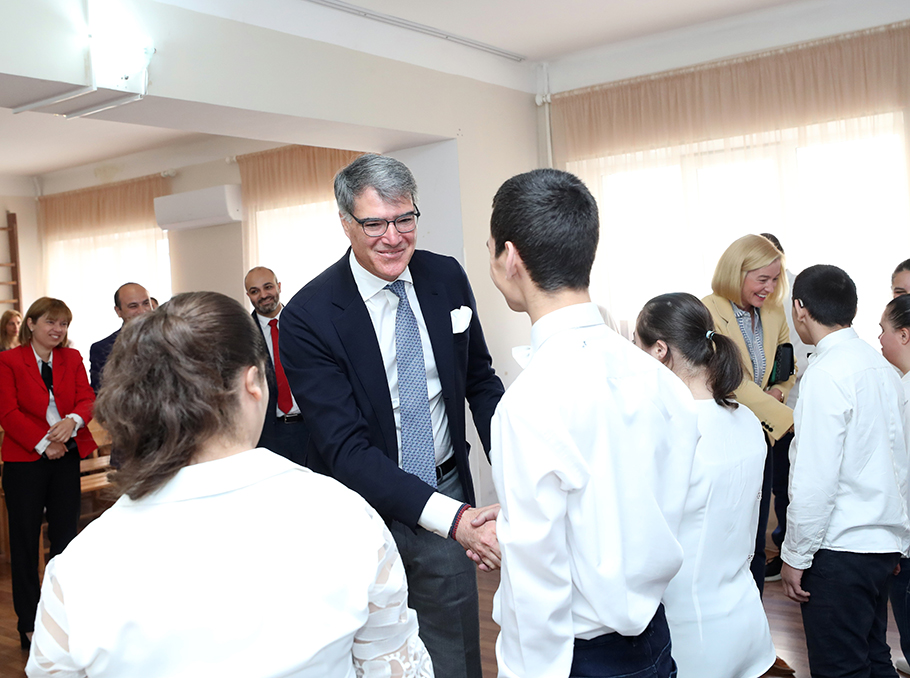
Over 231 children with special needs benefited from small grant initiatives carried out with the Source Foundation, the Arabkir Foundation and Step Forward NGO. These projects:
- improved access to assistive and adaptive furniture and devices.
- strengthened life skills that support independent living.
- enhanced the quality of life of orphans living at the Marie Izmirlian Orphanage.
The initiatives also created two new professional roles at Guykadaran Yerevan – a kinesiotherapist (adaptive sport and sensory integration) and an occupational therapist. As Guykadaran Yerevan was launched only recently and had limited outreach by end 2025, the number of children reached is expected to grow significantly.
32 parents and caregivers of children with disabilities were trained in using assistive and adaptive furniture and devices, helping them provide better care at home. This outreach is likewise expected to expand as the services at Guykadaran Yerevan scale up.
Transition from institutions to community based small group homes
In a landmark project, the Foundation, together with the Ministry of Labor and Social Affairs and Mission Armenia NGO, is designing a programme that gives people with disabilities residing in social care institutions a “next step” – moving from institutional care into small group homes within the community.
Two such community small group homes have already been constructed or rehabilitated under the “Supporting Graduates of Population Social Protection Institutions” project.
To support long term, system level changes, four policy relevant knowledge products were prepared: standard operating procedures (SOPs), an SOP for facility operations, terms of reference for standardized housing design (with detailed furniture specifications), and a needs assessment to define eligibility criteria for residents of community small group homes.
A revised draft law “On Amending the Law on Social Assistance” (including amendments to Government Decision N 1744 N) and a draft government decision on standard internal regulations for small group homes have been submitted to policymakers for consideration.
Looking Ahead
The results achieved in 2025 demonstrate the Izmirlian Foundation’s continued commitment to strengthening systems, empowering individuals and communities, and positioning Armenia for a resilient and inclusive future. Building on these achievements, the Izmirlian Foundation will further scale its impact in healthcare, education, social welfare, technological development and the Armenian language ecosystem, in close partnership with state institutions, civil society and international organizations.