





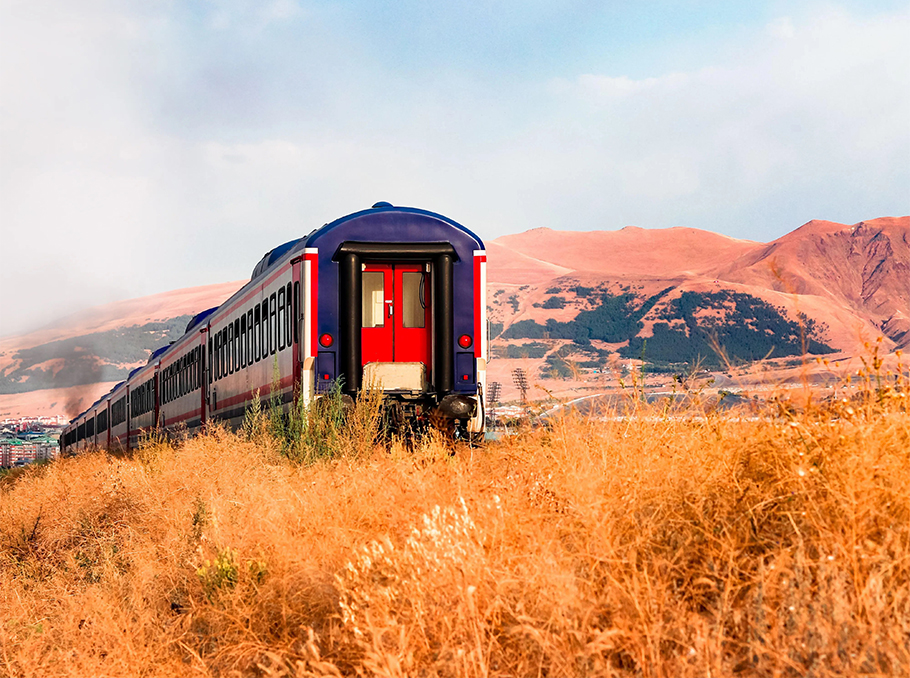

Armenia’s Foreign Affairs Ministry reported that on November 28, Armenia and Turkey held the second stage of technical discussions regarding the restoration and operation of the Gyumri-Kars railway. Representatives of the relevant agencies from both countries met at the Aghurian-Akyaka border checkpoint on the Armenia-Turkey border and in the city of Gyumri.
Here are 7 questions and answers about the railway.
1. When and why was the railway built?
After the Russo-Turkish War of 1877-1878, the Russian Empire gained the territories of the Kars region and Batumi. Kars became a strategically important outpost on the border with the Ottoman Empire, and a railway was needed to strengthen the Russian military presence.

The decision to build the Tbilisi-Alexandropol (now Gyumri)-Kars railway was made by the imperial government in May 1895.
Construction began in 1896 under the direction of engineer Evgeni Wurzel. On February 7, 1899, the first train arrived in Alexandropol from Tbilisi. By December of the same year, the section of the railway leading to Kars was also completed.
In 1902, the Alexandropol-Yerevan branch was completed, and in 1906, railway service was extended to Joulfa on the border with Iran, significantly expanding the region’s transportation capabilities.
2. What changed after World War I?
After Turkey took Kars, part of the railway on Turkish territory was converted from the Russian broad gauge (1520 mm) to the standard European gauge (1435 mm). This created the need for transshipment of cargo at the border.
During the Soviet period, the Gyumri-Kars section was the only direct railway connection between the Soviet Union and Turkey.
3. What were the volumes of transportation?
In the mid-1980s, about 65,000 tons of cargo were transported across the border annually, and by 1989, volumes reached their peak – approximately 180,000 tons.
Passenger traffic in the 1980s was also active. Regular passenger trains ran along the Moscow-Doğukapı route, and the Leninakan (Gyumri) station received up to 30 trains daily.
4. Why and when was the railway closed?
Turkey closed its border with Armenia and suspended railway communication in 1993 in solidarity with Azerbaijan. The Aghurian-Doğukapı border crossing was put out of operation.
5. What became the alternative, and what did Aliyev say?
In 2005, Turkey, Azerbaijan, and Georgia signed an agreement to build the Baku-Tbilisi-Kars railway, bypassing Armenia.
The Baku-Tbilisi-Kars railway, with a total length of 826 km, was commissioned on October 30, 2017.
Speaking in January 2025 at a meeting with government members, Azerbaijani President Ilham Aliyev stated that the United States had opposed the construction of the Baku-Tbilisi-Kars railway.

“We faced significant resistance when we wanted to implement this project. I can reveal this now - particularly, the United States opposed it. The reason was their pro-Armenian stance, as it was believed that this project would bypass Armenia.
We negotiated with the Georgian side for several years and finally managed to reach an agreement. I personally discussed this issue with US high-ranking officials on several occasions, telling them not to obstruct us. This is a strategic project for us, which in the future will benefit other countries, including their allies. Time has proven that, as always, we were right. Today, US partners in Europe have shown great interest in the Baku-Tbilisi-Kars railroad. In general, they are highly interested in the transportation of goods between Central Asia and Europe and in the opposite direction through the territory of Azerbaijan. Had this railway not been built, such transport routes would have been impossible,” the Azerbaijani president said then.
6. What was done as part of “football diplomacy”?
In 2008, repair work began on the 12-kilometer Armenian section of the Gyumri-Kars railway, which was purely symbolic in nature.
7. What are the prospects for restoring the railway communication?
In July 2024, special envoys for normalizing relations between Armenia and Turkey, Ruben Rubinyan and Serdar Kılıç, agreed to conduct a joint assessment of the technical condition of the railway.
Speaking in December 2024 at a meeting of the OSCE Council of Ministers in Valletta, Armenian Foreign Minister Ararat Mirzoyan stated: “We continue the dialogue with our Turkish counterparts and take some practical steps which include joint assessment of the bridge between Armenia and Turkey as well as the technical requirements for the border crossing by the Gyumri-Kars railway.”

In September 2025, Rubinyan and Kılıç met in Yerevan and agreed that the relevant authorities of both countries would carry out the necessary technical studies for the restoration and commissioning of the Gyumri-Kars railway and power line.
It is clear that the Kars-Gyumri railway can only be restored after the full establishment of diplomatic relations between Armenia and Turkey.
According to various estimates, restoring the Armenian section of the railway would take about one year and cost approximately $30 million.