





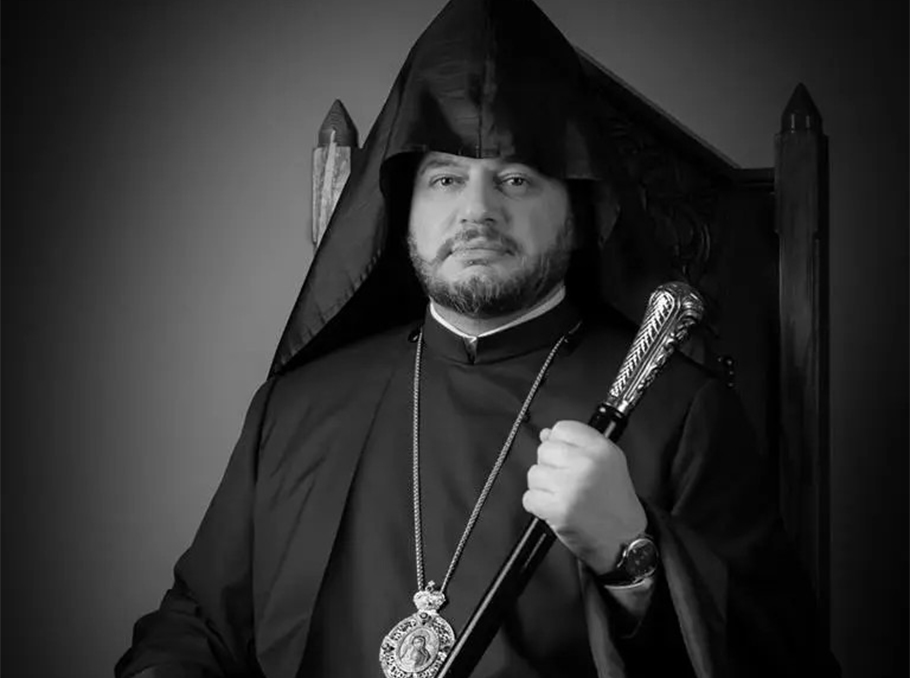

Yerevan /Mediamax/. The Primate of the Armenian Diocese of Canada, Bishop Abgar Hovakimyan, has addressed Armenian lawyers with a “message of conscience.”
The message reads:
“With this message, I address Armenian legal associations operating in various countries around the world, and especially in the Republic of Armenia. I regard you not merely as individuals practicing within different national legal systems, but as a single, integral community united by shared values and guided by a conscious commitment to the protection of pan-Armenian interests.
With deep concern, I must note that a number of governmental decisions and initiatives undertaken in recent years by the Republic of Armenia – decisions that clearly contradict fundamental national, constitutional, and spiritual values – have to date not received an adequate public or professional legal assessment.
In particular, this concerns the restriction of the freedom of movement of clergy of the Armenian Apostolic Church and the obstruction of their participation in the scheduled Assembly of Bishops. These are not matters of a merely administrative or procedural nature; rather, they directly implicate freedom of conscience and religion, as well as the internal autonomy of the Church.
One of the fundamental principles of international law is that freedom of conscience, religion, and association cannot be restricted on grounds of political expediency. International human rights law clearly affirms that the duty of the state is not to control these freedoms, but to ensure their full and effective exercise.
Today, however, the authorities of the “new” Armenia present the devaluation of traditional Christian values as the protection of human rights, thereby distorting the true substance of both law and values.
The government is attempting to treat the Church as an administrative or executive body, violating its internal autonomy and obstructing the convening of assemblies of pan-ecclesial significance. Clergy are subjected to absurd accusations devoid of legal basis, under the pretext of failing to comply with internal church decisions or of seeking to suspend them through judicial mechanisms. Meanwhile, the Armenian Apostolic Church has existed independently for centuries and has never been a state institution or a subordinate body.
As a result of these circumstances, the pan-ecclesial assembly is now compelled to convene outside the borders of the Republic of Armenia. This is due to the real and foreseeable risk of governmental interference. Yet this assembly is meant to address matters of exceptional importance concerning the present and future of the Armenian Apostolic Church.
Christian tradition is unequivocal on this matter: “Where there is no justice, authority turns into violence.” This teaching of the Church Fathers presents justice not as a pious aspiration, but as the boundary of the legitimacy of authority. The great representative of Armenian legal and philosophical thought, Mkhitar Gosh, articulates the same principle clearly in his Datastanagirk (“Book of Law”), noting that the law is called to protect the weak from the strong, not to become a tool of the strong against the weak.
Today, however, when legal issues concern matters of far deeper and pan-national significance – namely the freedom and autonomy of the Church, the fundamental rights of the clergy, and troubling initiatives at the state level involving the sale or donation of church property - an inexplicable silence prevails. In such circumstances, silence is inevitably perceived, whether intentionally or not, as consent or as an evasion of professional and moral responsibility.
A lawyer is not merely a technician who applies legal norms. A lawyer is also a bearer of justice, the rule of law, and civic courage. As Mkhitar Gosh once again emphasizes, a just judgment begins with conscience, not with instruction.
I expect that members of the Armenian Church within the legal profession will receive this message as a call to reexamine their professional obligations and to transform them into consistent and practical actions in defense of the values and rights that are today under threat in the Motherland.”