




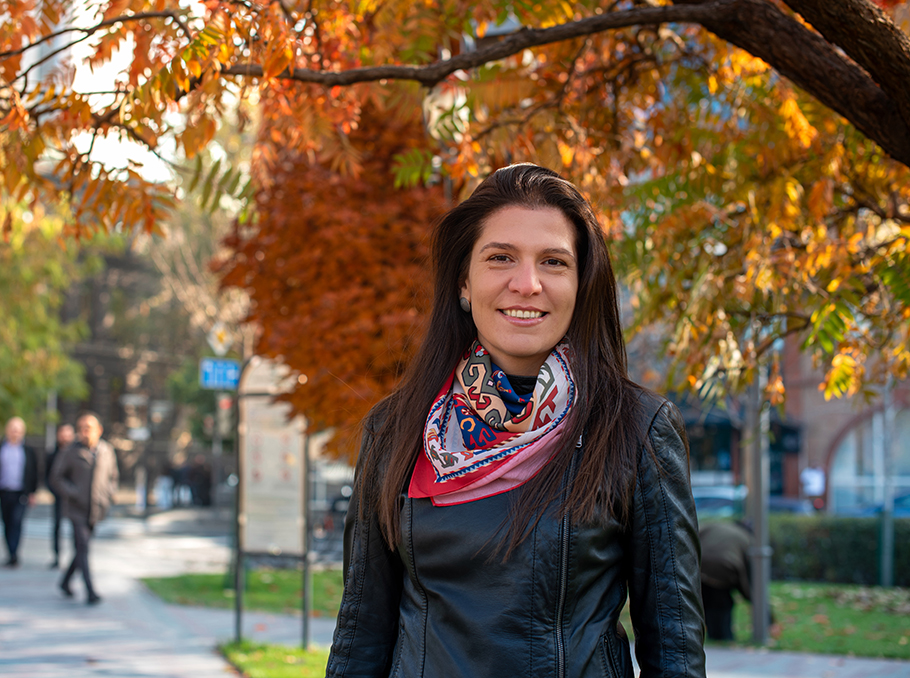

I met Nora in the hallway of the Office of the High Commissioner for Diaspora Affairs, just as she was about to step into a classroom for her Armenian language lesson. Delaying her only briefly, we had a short but heartfelt conversation. Nora explained that having grown up in Bulgaria, her connection with Armenia had always been fragile – so fragile, in fact, that at one point she almost lost it. Now, she said, she is here to discover Armenia and to rediscover herself as an Armenian.
That brief exchange was enough for me to realize this would not be our last conversation: a longer story was unfolding on her a journey between Plovdiv and Yerevan, where an Armenian identity started growing alongside a Bulgarian one.
An identity echoing through the spiritual music of childhood
Nora Radoslavova’s grandmother, Nvart Cherchiyan, was the choir director at St. George Armenian Apostolic Church in Plovdiv, leading a group of Armenian women over fifty whom she lovingly called her "girls." As a child, Nora would sit upstairs with them, listening to their sharakans – Armenian liturgical chants – while watching life in the church unfold below.
Her mother and father, both opera musicians, traveled constantly for work, so she spent most of her childhood with her grandmother. The warmest memories that connect her to Armenia trace back to those hours spent together – memories she began to reflect on more deeply after visiting Armenia herself.
Both of Nora's grandparents arrived in Bulgaria as children in the aftermath of the Armenian Genocide. Her grandmother Nvart came from Istanbul, her grandfather, Vahe Cherchiyan, came from Edirne: both settled in Plovdiv in the 1930s. The city still has Bulgaria's largest Armenian population, though it is gradually diminishing.
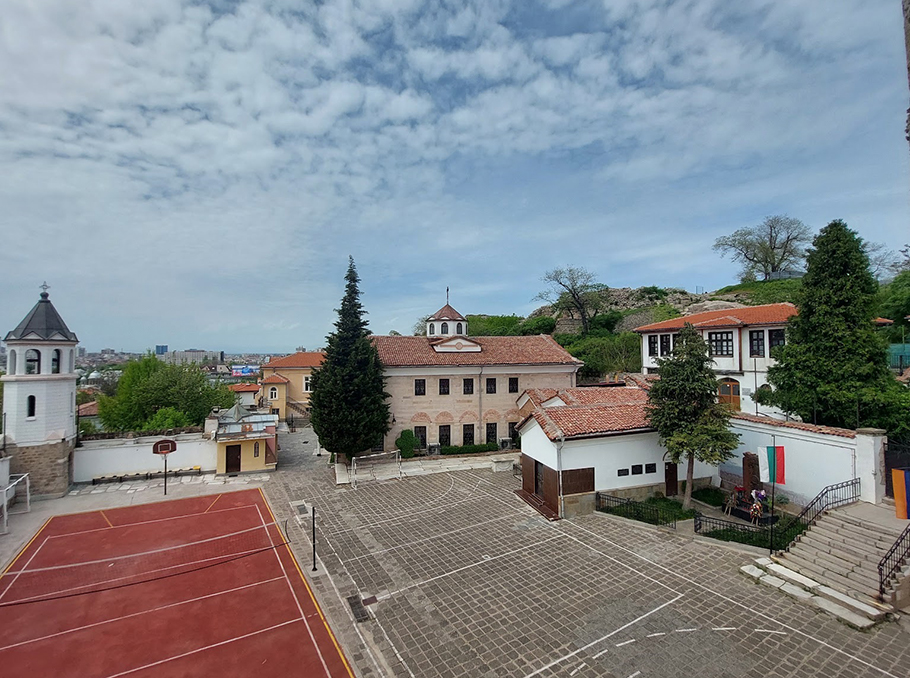 St. George Armenian Apostolic Church in Plovdiv
Photo: St. George Church
"My mother, Lusona Vahe Cherchiyan- Radoslavova, was very active in the Armenian community, back when the community really felt like a community," Nora explains. "Back then, so many Armenians had fled from Turkey, and they all wanted to stick together. There was much more community life then. Not like now, when we are melting and that sense of togetherness is no longer the same, as I believe is the case in many other Armenian communities around the world."
Nora's father, Radoslav Radoslavov, is Bulgarian. She says she inherited his features, and partly his character, but her energy and heart – the way she connects with people – is Armenian. "My mother had the energy of three Armenians, and she gave one of them to me," she says with a smile.
Nora attended Armenian school until the age of fourteen, but after transferring to a Bulgarian school she gradually forgot most of Armenian language she had learned. Her friends and daily environment were Bulgarian. When she entered Plovdiv University to study English philology, the pattern continued – her social world remained almost entirely Bulgarian. But in 2004, she found her way back to the Armenian community, this time as a volunteer at AGBU Plovdiv.
AGBU was a flourishing organization at the time and had just begun publishing a newspaper focused on community life. Nora was invited to join as a journalist-contributor. The paper was a small operation – just three people – and Nora was involved in nearly every aspect of its production: attending events, interviewing, taking photos, translating, and even folding newspapers for mailing.
"I started to get involved, and it connected me with every person," she says. "Later, I also joined AGBU's Young Professionals division, and at some point I was spending more time there than at the university," she says with a smile.
The unexpected, yet necessary turns before Yerevan
By 2008, too much activism had begun to feel constraining. The community felt small, the same routines repeating themselves, and Nora felt an urge to step away. She focused on her master's program in international economic relations at University of National and World Economy in Sofia, took internships abroad, and worked in HR, administration, and investing. Though she loosened her involvement, she never fully cut ties with AGBU, continuing to help whenever needed.
In 2024, she moved back to Plovdiv from another Bulgarian city – Varna with a clear purpose: to reconnect.
"I wanted to rebuild my old connections, because with these people I feel very comfortable," she says. "The Armenian community has a way of communicating and a set of values that are not just spoken about – they are simply present. I wanted a fresh start, and the community was very happy to welcome me. I was like what we say in Bulgaria, 'freshly baked hot bread.'" She later explains the expression: freshly baked bread is always desired, tasty, and eagerly awaited, especially when people are hungry.
Soon after, Nora was elected co-chair of AGBU Plovdiv, a development that became crucial in her path toward an actual life in Armenia. She had been planning to visit Armenia as a tourist when AGBU suggested she join a summit in Yerevan that required a representative from AGBU Plovdiv – the Global Armenian Summit 2024, organized by the Office of the High Commissioner for Diaspora Affairs. During the summit, she connected with many people.
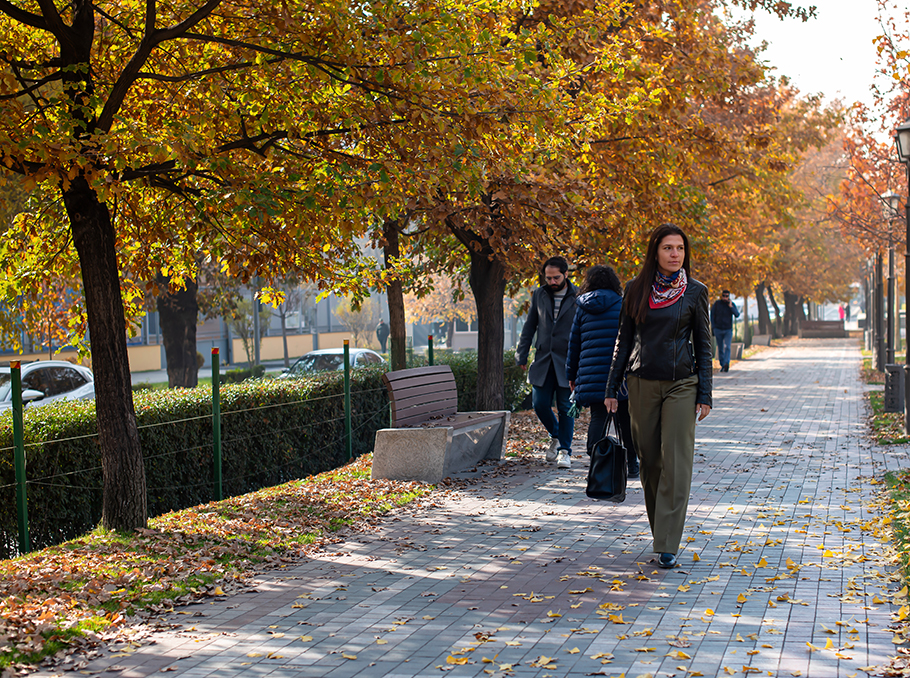 Nora Radoslavova
 Photo: Mediamax
"I felt very much at home," she says, recalling those days. "My Armenian wasn't perfect, but difficulties are easily solved with energy talking."
Nora arrived in Armenia with no specific expectations, which allowed her to fully absorb the experience. Her first impression was of people being open, friendly, and sincere.
"People here don't play the game in front of you – they are who they are," she says. "I keep saying this is because Western mentality hasn't reached you with full force yet. I really like this honesty; it reminds me of childhood."
It was during the summit that she first heard about the iGorts program launched by the Office of the High Commissioner for Diaspora Affairs. It invites Diaspora Armenian professionals to serve in the public sector and in the government of the Republic of Armenia. The idea of joining the program stayed with her, though she continued to second-guess herself. "I can't be there; I don't speak Armenian well."
“At one point, while I was changing jobs in Plovdiv and looking for something new, the representatives from the Office of the High Commissioner for Diaspora Affairs visited Plovdiv Armenian Community during their Europe tour. After hearing about the program once more I decided to apply”.
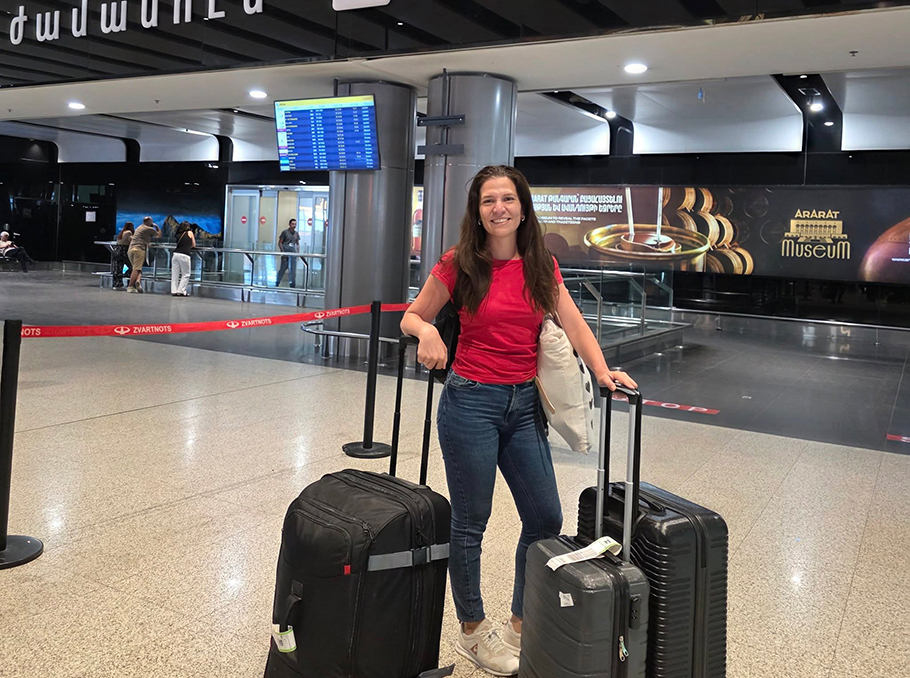 Nora Radoslavova
 Photo: Nora’s personal archive
That decision brought Nora to Yerevan in September 2025. She now works in the Diaspora Potential Mapping and Involvement Department of the Office of the High Commissioner for Diaspora Affairs. The program is designed to last one year, but Nora already has some thoughts on extending her stay.
Old rituals, new challenges
Morning walks have long been part of Nora's daily routine. Back in Plovdiv, she would wake up, have her coffee, and walk uphill as a small daily ritual – exercise paired with a view as a reward. Walking, she says, helps her think more clearly: ideas fall into place, plans take shape. When she decided to continue this habit in Yerevan, the Cascade felt like the most logical choice. Even if the air is not always clean and the view is not always clear, she thinks it is better to walk than to stay at home.
"Last year, when I was in Yerevan and climbed the Cascade stairs for the first time, I suddenly thought it would be a nice place for exercising. For a second, I could already see myself doing sports there. Later, when I chose a house and realized it was close by, it came to me that you really have to be careful what you wish for – because sometimes it actually comes to you."
For years, not speaking Armenian felt like a quiet but persistent discomfort. Each encounter within Armenian communities reminded her of what was missing, as at some point the conversations would switch to Armenian, where she could not fully take part.
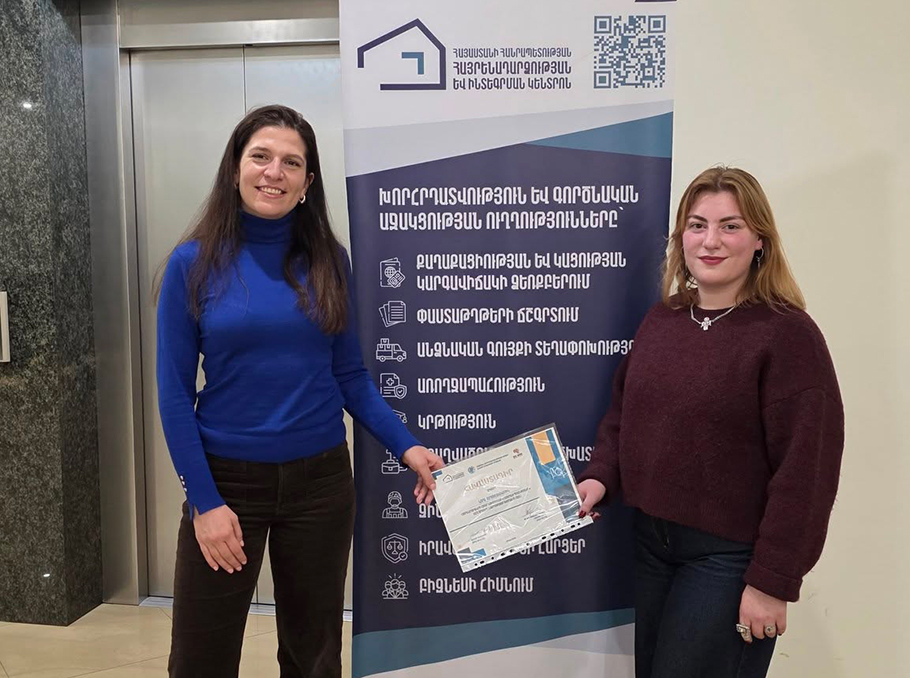 Nora after Completing 1st level of Armenian language
Photo: Nora’s personal archive
"I could always communicate in English and connect with people that way. But you're in Yerevan – you're not in the US or the UK – and it hits you. So I started learning Eastern Armenian, because I understood that if you know Eastern, you understand Western. My goal is to speak and manage daily life in Armenia. Reading and writing are still slow – I know the letters, but I'm like a first-grade child. For now, English helps me more than Armenian, but that will hopefully change soon."
Armenia still standing strong as the pillars of ancient churches
Nora's exploration of Armenia has unfolded less through guidebooks and more through people. With a mix of English and limited Armenian, she has started conversations even on the streets, which often end up with making new friends and a joint trip to Armenia's beautiful sights and historical places.
"Locals, especially once they see my desire to reconnect with my Armenian identity, are so nice and always offer their help. I try to visit as many places as possible, and first I try to feel the place and only after read about it. I want to go deeper into those feelings." Nora also has opened pages on social media called "NORA in Armenia" to share her experiences.
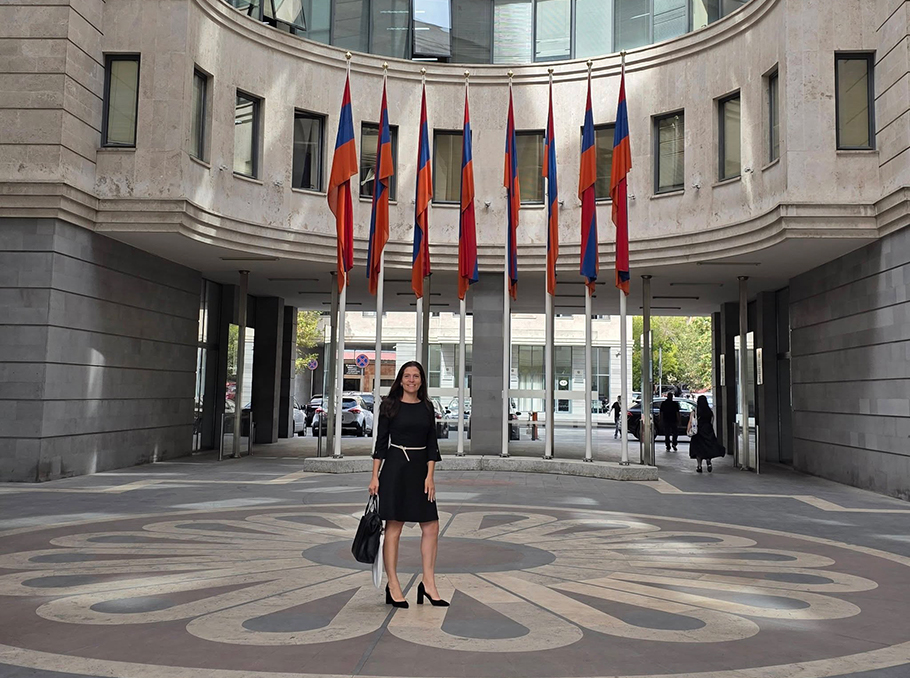 Nora Radoslavova
 Photo: Nora’s personal archive
For Nora, Armenian ancient monasteries all over the country are among the key places to visit. The realization of how strongly the Armenian nation is connected to its religion, which began back in Plovdiv, has now only deepened.
"Religion is one of the pillars of Armenian identity; it keeps people together. This is why Armenia – a country that has lived through so many difficult situations – has survived, and why Armenians in the diaspora have survived as well. They had churches and schools next to them, places where people could feel Armenian and feel Armenia there," she says, adding, "When I came here, I realized that I do feel Armenian, but I also feel that there is so much I do not know."
Standing inside ancient churches or touching the stones, Nora felt the weight of centuries in a way she had not anticipated. " When you touch the stone, you can feel the ages before, the people who were here long ago. You step on stones made centuries ago, and they still exist – just like this country, which, despite a difficult destiny in recent years, is still standing strong. And that is very admirable."
"Why do you keep saying 'tsavd tanem' to me?"
People's ways of thinking, their inner worlds, are often expressed most clearly in their mother tongue. Many set phrases that are an inseparable part of everyday Armenian life are not only impossible to translate, but difficult even to explain. Nora has already heard and learned several of these expressions, yet she still doesn't fully understand them.
"When the cleaning lady came to my flat, I asked her to hang the curtain because it was falling, and she said 'tsavd tanem' (author's note: literal meaning, 'I'll take your pain'). Then she continued saying something else and again, 'tsavd tanem.' I keep hearing this expression, and I don't understand why you say it so much, why you say 'tsavd tanem' to me?" Nora asks, laughing, though clearly confused. Then she adds, "But there's an even more dramatic one – 'jigyard utem' (author's note: literal meaning, 'I'll eat your liver'). I don't want you to eat my liver."
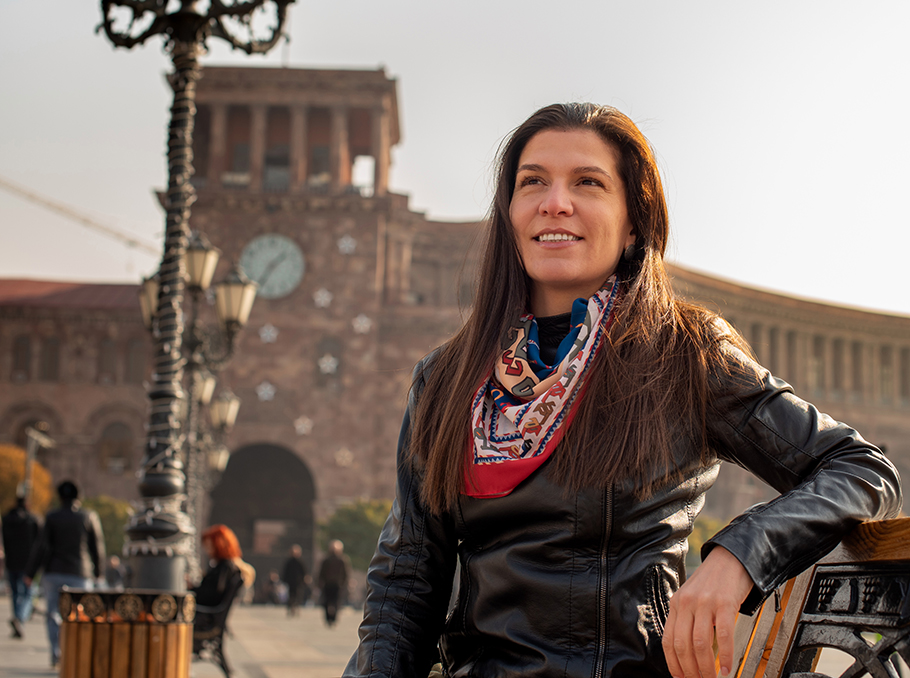 Nora Radoslavova
 Photo: Mediamax
Despite an overall sense of familiarity, several elements of Armenian social culture still surprise Nora. Once, for example, one of her newly made Armenian friends invited her for coffee at home. Having already eaten a filling lunch, she went to drink a cappuccino, exactly as they had agreed – and was unprepared for what awaited her.
"I walked in and saw a table full of all kinds of food. I immediately imagined how impolite would be not to respect the effort of the host to cook all this food and that everyone would start pushing me to eat so much that I wouldn't be able to sleep at night. I decided I wasn't going to eat. I drank my cappuccino, they ate, and we still had a nice conversation. Later, I called my mom and told her I had been invited for coffee, but the table was completely full. She asked, surprised, 'Well, what did you expect?' I said, 'Coffee. I was invited for coffee, so I expected coffee,'" Nora recounts, slightly irritated, trying to explain what seemed to her a simple and logical expectation.
Her mother's response was that no matter how illogical that coffee table seemed, it was, in fact, very Armenian. Hearing such stories from Nora makes her happy, because now her daughter can experience things she was unable to fully pass on.
"My mother had seen all of that Armenian hospitality through my grandparents. They were a typical Armenian family – always had guests, and my grandmother would cook the whole world and put it all on the table," Nora recalls warmly, adding that even though her grandparents are no longer alive, they would surely be happy to know she is in Armenia.
"They inspire me on this journey," she says. "In a way, I'm also living their unfulfilled dream."
Gaiane Yenokian
Photos by the author and from Nora’s personal archive