





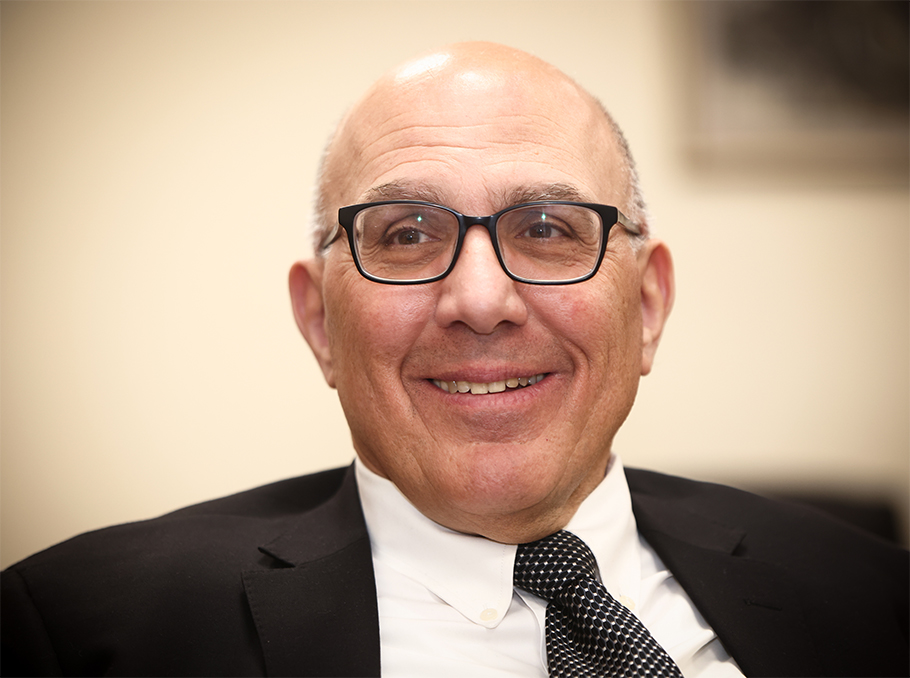

As the American University of Armenia looks ahead to the next decade, its Strategic Plan 2024–2034 sets out a vision for educating future leaders capable of contributing meaningfully to Armenia and the global community. In a recent interview with Mediamax, AUA President Dr. Bruce Boghosian discusses the university’s priorities for growth, including the planned construction of a new building cluster, AUA’s approach to expanding research capacity, and the pipeline of new bachelor’s, master’s, and prospective Ph.D. programs. He also reflects on the essentials of nation-building and the role of the university in shaping Armenia’s future.
- In our previous interview, which took place about two years ago, you mentioned the construction of a new academic building as one of AUA’s future priorities, noting that the university is forced to reject many strong applicants simply due to space limitations. The Strategic Plan 2024–2034 now clearly links future growth to a new building cluster. Where does AUA currently stand on this project?
- The problem you refer to has not gone away; we still do not have sufficient space to accept all qualified applicants, so we remain committed to expanding our facilities with the addition of a new building on land that we own on Sose Street. Currently, our architects have finished the material needed for the Planning Permission and we are in the application process. Construction will take some time, but our growth is limited by physical space at this point, and demand for an AUA education continues to grow. So, this is an imperative for us.
Additionally, we have assured the Armenian government that when they complete the first phase of work on the planned Academic City, we would like to be a part of it. We do not see this as conflicting with our Sose Street project at all. We could certainly use dormitory space in the Academic City, which we need very badly, and which I understand is one of the first things that will be ready. In the fullness of time, we could build much-needed laboratory space there, and perhaps even move one or more programs there when the Academic City is ready to receive that kind of participation from us.
- The expansion of AUA’s physical capacity is also expected to support the growth of research. What other steps is the university taking to strengthen its research capacity?
- The construction of the new building on Sose Street will allow us to increase laboratory space, which is essential to the development of research capacity – another major focus area of AUA’s Strategic Plan.
One of the most concrete steps in this direction is the approach of providing research-active faculty with course releases. When faculty demonstrate strong research performance – such as publishing in high-impact international journals and effectively mentoring students in research – we want to be able to reduce their teaching load so that they have more time to focus on their research programs. This approach is supported by both the teaching release program of our Faculty Research and Awards Committee and the newly introduced JACE Foundation Grant.
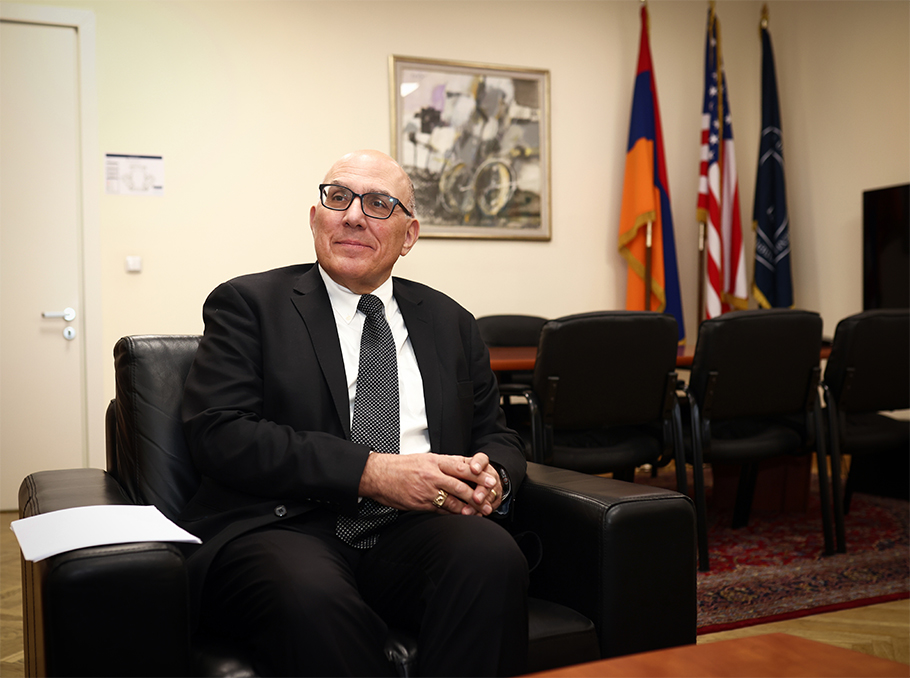
Photo: Mediamax
Further to this goal, we now require that all new incoming full-time faculty have an active research agenda as a condition of employment. We expect that arriving full-time faculty will come with an active record of publications, international research collaborations, recognition in their fields of specialization, and service to the institution and the profession. This is enshrined in our policies, and we are working on ever more precise Key Performance Indicators for faculty to make these concepts quantitatively precise.
In Fall 2024, we became the first university in Armenia to establish an Office of Sponsored Programs and Technology Transfer to oversee and raise awareness of intellectual property (IP) management at the University. Our Office of Sponsored Programs and Technology Transfer has created an Invention Disclosure Portal so that our employees can disclose and receive advice on IP that they have generated at the University. This Office worked with one of our faculty members to file the first patent application by a university based in Armenia, to the best of our knowledge, and more are in process.
We are also actively adding and enhancing international interdisciplinary partnerships. Last year, AUA announced the launch of the Center for Ethics in Public Affairs (ETICA), which was established through a €2.5 million grant from Horizon Europe’s highly competitive and prestigious European Research Area (ERA) Chair funding program. To date, Armenia is the first country in the South Caucasus to receive such ERA Chair grants. The first ERA Chair award in Armenia was granted in November 2022 to Dr. Narine Sarvazyan, William Frazer Endowed Professor at AUA, whose Chair award was hosted at Yerevan’s Orbeli Institute of Physiology.
AUA’s Acopian Center for the Environment also leads the Strengthening Research in Armenia for Energy Transition toward Climate Solutions (STREACS) project, funded by the EU Horizon Europe program, and we expect that more research initiatives of this scale will be announced soon.
At the same time, we are working to improve career development opportunities for faculty and staff and to strengthen AUA’s position in global university ranking metrics. There is much work to be done as we pivot to become a more research-focused university.
- Another goal outlined in the Strategic Plan is the introduction of new undergraduate programs to support AUA’s growth and better respond to the country’s needs. What kinds of new programs can we expect in the coming years, and what criteria guide the university when deciding which programs to introduce?
- The introduction of new undergraduate programs is closely linked to the growing demand for an AUA education and our goal of meeting Armenia’s educational needs. At present, AUA offers more graduate programs than undergraduate programs, even though we have significantly more undergraduate students than graduate students; therefore, we need to rebalance our academic portfolio by introducing additional bachelor’s-level programs.

Photo: Mediamax
In September 2025, we launched a Bachelor of Science program in Economics, in part to further our long collaboration with the Central Bank of Armenia. In some cases, the introduction of new undergraduate programs will involve refining existing programs; for example, we currently offer a bachelor’s degree in Engineering Sciences, which we are likely to split into two or three more specialized degrees: Mechanical Engineering, Electrical Engineering, and possibly Mechatronics. In other cases, we can make use of existing courses to develop new degrees; for example, we already have so many mathematics courses that, with the addition of just a few more and some dedicated faculty, we could create an Applied Mathematics major.
Aerospace Engineering is another possible program direction that we are currently exploring in collaboration with the Armenian Society of Fellows.
Meanwhile, we continue to develop graduate programs. Our Master of Arts in Multiplatform Journalism program was introduced in June 2025, and we are also developing plans for an MA in Education program.
When designing new programs, one of the first steps we take is to conduct a market study to assess the demand for a degree in Armenia. Our goal is to ensure that graduates can find jobs, ideally in Armenia, and contribute to the economy, the government, and the country’s long-term development.
To get back to your question: Based on this analysis, we prepare a proposal explaining the need for the degree, which is reviewed both by our U.S. accreditor, the Western Association of Schools and Colleges (WASC) and by Armenia’s Ministry of Education, Science, Culture, and Sport. These reviews focus on whether there is a real need for the program and sufficient demand for its graduates, and whether the budget for the new program makes sense. In some cases, new programs are also introduced because they complement other academic offerings we plan to develop.
- The Strategic Plan foresees possible introduction of AUA’s first Ph.D. programs. In which fields are these doctoral programs most likely to be developed?
- The Ph.D. programs most frequently discussed for the future are a Ph.D. in Computer Science and a Ph.D. in Economics, the latter in collaboration with the Central Bank of Armenia. The primary reason for this is that, for our first doctoral programs we will need to focus on fields in which we already have sufficient depth of experience and faculty capable of advising Ph.D. students, which is a substantial commitment.
While master’s students are expected to write a thesis that brings them to the frontier of a field and perhaps slightly beyond, a Ph.D. must involve new scholarship of discovery. This level of research demands significant advisory engagement from faculty.
In Economics, we are well positioned in this regard. We have had a master’s program in Economics, funded by the Central Bank of Armenia, since 2013. More recently we have also introduced a bachelor’s program in Economics. At this point, we have a strong group of research-active faculty teaching Economics who have published extensively, are active members of the Armenian Economic Association, collaborate with researchers worldwide, and have experience at international universities. As a result, they are well prepared to supervise Ph.D. students.
Photo: Mediamax
I can say with the same confidence that we have comparable depth and expertise among our faculty in the field of Computer Science. This is why these two fields have been identified as the most viable options for AUA’s first Ph.D. programs.
The earliest these programs could be launched is September 2027, though September 2028 is more likely.
- The university also places a strong emphasis on multidisciplinary thinking and the concept of general education. How does AUA’s General Education Program support this goal, and why is it essential in today’s global environment?
- AUA takes care to introduce new programs in areas for which there is demand in Armenia's growing economy, and our students have a very good record of going into industry or onto other academic positions. At the same time, our goal is to create broadly educated individuals who are conversant with all the great ideas of intellectual history, be they in the natural sciences, the social sciences, or the humanities, regardless of their major.
For this reason, an AUA degree is built upon two inseparable components: the major and General Education. While the major provides students with depth, specialization, and career preparation, General Education provides breadth and a foundation of general knowledge and skills for life. It aims to develop articulate, conscientious citizens and problem solvers who are committed to contributing to their fields and society, and to provide our students with a broad foundation of knowledge, skills, and perspectives.
There are many examples I could cite supporting this approach: If the focus of your major is political science or environmental sciences, you had better know something about economics. If the focus of your major is economics or nursing, you had better know something about mathematics. If the focus of your major is computer science or artificial intelligence, you had better know something about ethics. (In fact, everybody ought to know something about ethics.) For all these reasons, we take General Education very seriously.
Along these lines, we have restructured our approach to General Education by moving all related courses, faculty, and minors into the colleges, while also reviewing and considering new courses for inclusion in the General Education curriculum. In addition, we appointed a new Academic Director of General Education, who began his work at the University this past summer.
- The Strategic Plan also sets a target of increasing the proportion of full-time faculty from about 36% to 50% within five years. What are the main challenges in achieving this goal?
- A good fraction of our full-time faculty is hired from abroad, since prior experience in American or Western universities is highly valued here. Our Strategic Plan also prioritizes increasing the fraction of foreign students from about 10% to about 20%. These goals do present challenges, as you suggest.
Our Strategic Plan contains a SWOT analysis that mentions some of these challenges alongside opportunities: AUA offers a competitive salary and supplementary benefits for international faculty members, and we believe we do a strong job of providing a welcoming environment for them.
At the same time, there are “geopolitical considerations” that complicate student and faculty travel: Due to limited or biased coverage of the region in the Western press, many people are not aware that Armenia is a safe and pleasant place to live.
In addition, we do not yet have nearly enough dormitory space for foreign students, nor do we have apartments to offer to foreign faculty. Finally, there are visa requirements for employment or study in Armenia that must be satisfied.
- Alongside its ambitious development plans, AUA emphasizes the need to remain affordable, with tuition capped at around 50% of total revenues and a continued commitment to need-blind admissions. How does the university plan to sustain this model while nearly doubling in size?
- We are committed to the principle that no qualified Armenian student should be denied an AUA education because of inability to pay tuition. Hence, we offer full-need and need-blind financial aid, which only a small minority of private universities in the United States is able to do. This means that we decouple admissions decisions from the amount of financial aid needed, and accept students on the basis of merit only. Our scholarships, with few exceptions, are need-based. We give back 26% of tuition revenues in the form of financial aid. That said, our tuition covers only 40% of the cost of educating our students. We are able to sustain this business model only because of the generosity of our committed donors who provide both annual and endowed gifts.
Photo: Mediamax
With these generous gifts, and taking advantage of the economies of scale, we have grown our student population by a factor of seven in the last 16 years. Our buildings are full now, and for the moment there is no room for us to grow to meet demand. This is why we are committed to constructing a new building.
- Following recent media reports containing misleading information about the appointment of Dr. Lilit Makunts to the AUA Foundation Board – including claims that she was “hired” for political reasons – could you clarify how governance functions in the case of the AUA Foundation?
- The AUA Foundation (AUAF) was founded jointly by the Republic of Armenia and AUA’s nonprofit entity in the United States for the purpose of allowing us to operate and grant degrees in the Republic of Armenia. Hence, the Republic of Armenia is a founding entity of AUAF, and we have enjoyed close cooperation with every post-independence Armenian government over the last 35 years. To this day, the AUAF Board of Trustees consists of seven members, two of whom are representatives of the Government of the RA.
Yes, I saw a few articles in the Armenian press which suggested that Dr. Makunts' appointment to the AUA Foundation's board was politically motivated. I wish that they had simply contacted us to comment on the story before they printed it, as is common practice in responsible journalism, since we could have corrected their misconceptions. There is critically important context that is missing in this coverage.
To make matters worse, one of these stories was printed in somewhat modified form by a diasporan Armenian news outlet based in the Boston area, which also did not contact us in advance of going to press.
So, thank you for raising the issue, and please allow me to take a moment to set the record straight: As I mentioned, the government of the Republic of Armenia is one of the founding entities of AUAF and, according to our Board's bylaws, appoints representatives to two seats on its board. This is nothing new; they have always done so since our founding. Dr. Makunts now occupies one of those two seats; the other one is occupied by the RA Minister of Education, Science, Culture and Sport, Dr. Zhanna Andreasyan.
That said, I want to emphasize that the nomination of Dr. Makunts was a mutual decision between the RA government, the AUA administration, and all the other members of the AUA Foundation's Board, who confirmed her nomination unanimously. She was nominated and confirmed due to her exceptional credentials, namely those of a scholar who understands both the Armenian and American contexts very well, thanks to her years of experience as Armenia's ambassador to the United States. We are very fortunate to have input and advice from both Minister Andreasyan and now Dr. Makunts, and we are very grateful for their contributions to the American University of Armenia.
- Can you explain how AUA’s policy on political and religious activity works in practice, particularly how the university encourages civic engagement while avoiding institutional partisan political activity?
- The simple fact is that AUA, as a non-profit organization in the United States and a Foundation in the Republic of Armenia, does not and must not have any political or religious affiliations. This requires some explanation.
First, it is important to note that the academic study of politics or religion is protected by the principle of Academic Freedom, so problems can arise only for partisan political or religious speech by our employees. Even that is protected to a large extent, and we encourage our employees to be active citizens in this regard, so long as they make it clear that they are speaking for themselves and not for the University. They must not even give the impression that they are speaking for the University on such topics because, again, AUA does not and must not have any political or religious affiliations.
In fact, our policy on political and religious activity recently underwent some updates to make the above point even more clear by including the following statement:
“AUA maintains that when its faculty, staff or students make public comments – even on personal social media pages that mention their AUA affiliation – such statements represent their own views, and not those of the University, unless expressly stated otherwise.”
We hope that the public will keep these considerations in mind when they see public pronouncements by members of the AUA community. From time to time, I see editorials saying, in effect, “One or another person is from AUA and they said this or that, and isn’t that terrible?” It is important to us that both the public and the government understand that when they see AUA employees do that, their default assumption should be that those employees are speaking for themselves and not for the University. As long as their speech is responsible and appropriate (As described in the famous 1940 Statement on Academic Freedom and Tenure), we support their right to say what they wish, but we do not and must not subscribe to any partisan statements they might make regarding politics or religion.
– As AUA marks its 35th anniversary, how do you plan to reflect this milestone? Looking back, which elements of AUA’s identity have proven most resilient, and which do you believe need to evolve to meet future challenges?
– Our 35th anniversary is an important milestone for us, as it is for the Republic of Armenia, since we were both founded on the same day. We are proud of the fact that, over the years, we have shown agility and adaptability in adding new programs to meet the evolving needs of the government and the industry of the Republic of Armenia.
Photo: Mediamax
Regarding identity, we believe that AUA is the largest and most successful investment that the diaspora has made in Armenia since independence. It is an affiliate of the University of California, it provides Western higher education in a liberal arts style, and it is the only American-accredited university in the post-Soviet region. It has been the first to introduce features that are new to the Armenian milieu, too numerous to mention, but let me give just a few examples:
- Full-need and need-blind financial aid, dedicated to the proposition that no Armenian student should be denied an AUA education due to inability to pay tuition.
- A library that is open to the public.
- Inclusive and collegial governance, including a Faculty Senate, a Student Council, and a Staff Assembly.
- A state-of-the-art whistleblower policy, the first of its kind in Armenia.
- A new office devoted to Sponsored Programs and Technology Transfer that recently filed the first patent application from a university based in Armenia.
As we have already discussed, the directions of our future development include enriching our academic programs, introducing Ph.D. programs, expanding our research capacity, pursuing domain accreditation and international ranking, and expanding career development opportunities for faculty and staff. I could, of course, continue, but what I have outlined is sufficient to give a sense of the kinds of challenges that keep us awake at night.
Additionally, we do plan celebrations for our 35th anniversary, and details about this will be forthcoming.
- In our previous interview, you noted that AUA’s mission extends beyond education to nation-building. What expertise, as well as which human qualities, do you believe Armenia needs most today, and what is AUA’s role in developing them?
– We want to produce thoughtful, educated students who will contribute to the academic endeavor, the economy, the industry, the culture, and the defense of Armenia. I mentioned the last two in particular because we live in a complex and dangerous world, and therefore we need to defend our borders: but, at the same time, we also need to preserve our unique culture, because that is the kind of thing that makes a country worth defending.
Alongside this, radical new technologies, such as generative artificial intelligence and , offer both great promise and great danger in equal measure, and we want to produce graduate students who will help guide Armenia through the enormous societal changes due to technological advances that are on our doorstep.
We want to produce students with international scope and perspectives who will connect Armenia to the global value chain, enhancing the country's standing in the world and its trading position, and building the country's reputation as a unique center for innovation, free thought, and democracy - things that should not be taken for granted in this part of the world. We endeavor to produce graduates who will help Armenia navigate this complex and dangerous world with knowledge, expertise, confidence, and courage. What could be more important than that?
So, our mission expands far beyond the classroom – from the work that AUA EPIC does to build the entrepreneurship ecosystem in Armenia, to our disciplinary and independent research centers that focus on areas critical to Armenia’s development, and much more. Each one of our four Colleges has a research center, and each of those centers is actively working on topics that help us improve national policy, public health, the environment, and more.
To make my answer more concrete, I would like to mention two examples of how we are working beyond the classroom and supporting Armenia’s development․
Photo: Mediamax
The first one refers to the role of AUA’s Acopian Center for the Environment and its support for Armenia’s preparation for the hosting of the COP-17 Conference on Biodiversity this coming October. AUA’s Acopian Center for the Environment is a key partner in the “Road to COP-17” initiative also organized by the RA Ministry of Environment, the Secretariat of the United Nations Convention on Biological Diversity (CBD), and the RA Ministry of Foreign Affairs.
I would also mention AUA’s Extension Program, which is the non-degree arm of the AUA, offering certificate programs, courses and workshops especially geared to meeting the educational needs of the general public from diverse backgrounds, occupations, and professional pursuits. Extension works closely with governmental organizations and corporate entities to identify the specific training areas that must be met. Our Extension Program designs and develops a wide range of courses, including language classes, test preparation courses, and professional development workshops in demand, revisited annually. Through its regional centers across Armenia, in Gyumri, Goris, Kapan, Vanadzor, and Yeghegnadzor, AUA Extension brings a rich learning curriculum to local residents for them to thrive and aptly contribute to the development of their communities.
There are many other examples that I could mention along these lines. I think that AUA has already done a great deal to help strengthen the infrastructure of the Republic of Armenia, and that the Armenian government and public appreciate very much the role that it has played. I also think that the best is yet to come.
In today’s complex geopolitical environment, we must consider carefully where we want Armenia to stand. My personal vision for Armenia is to leverage its unique geopolitical position to play a constructive role in restoring peace and stability in the world.
Gaiane Yenokian talked to Dr. Bruce Boghosian
Photos by Emin Artisakesyan